


A shared fermentation workshop can produce an enthusiastic collection of photographs and a confusing collection of measurements. One person records a jar number, another writes “day three,” and someone else measures only the liquid. A useful notebook gives those observations enough context to be compared.
The aim is to document a process clearly, not to replace a tested food-preservation method with an improvised experiment. Keep the recipe and food-safety instructions alongside the record, while using the notebook to distinguish samples, instruments and changes over time.
Give every batch and sample a stable identity
Assign a batch code before collecting measurements. If several jars belong to the same preparation, give each jar a separate identifier within that batch. Avoid identifying a sample only as “the large jar” or “the one by the window,” because those descriptions can change.
A fictional code such as Workshop-A, Jar-02, Sample-03 tells another participant how the observation relates to the preparation. The code does not need to contain personal information. Its job is to preserve a traceable relationship between the record and the material observed.
Record the actual date and time as well as elapsed time since preparation. “Day three” can mean different intervals when groups start at different times of day. A dated record allows those intervals to be reconstructed without guessing.
Keep the tested method visible
The National Center for Home Food Preservation’s fermentation guidance explains that ingredient proportions and process requirements matter. A community demonstration should retain its chosen tested method rather than quietly changing conditions and treating the original instructions as still applicable.
Place the method’s title and version or access date at the front of the notebook. Note which batch follows it. If an ingredient was unavailable or a step was missed, record that deviation rather than editing the original instruction to make the record appear consistent.
A measurement can help describe what happened after a deviation, but it does not automatically validate the altered process. The notebook should make the difference visible to whoever is responsible for the workshop’s food handling.
Record calibration as its own event
A pH meter needs appropriate calibration and handling. The University of Minnesota’s food pH-meter guidance describes calibration and measurement considerations, including the importance of identifying the material being tested.
Give calibration its own dated row rather than writing “calibrated” once on the cover. Record the instrument identifier, the reference solutions used and whether the procedure completed as expected. Follow the meter’s instructions for preparation, cleaning and storage.
Do not copy a successful calibration entry from a previous session into the current one. A shared instrument may have been handled differently between uses. The record should describe an action that occurred, not an assumption about what someone probably did.
The number of decimal places on a display is not the same as demonstrated accuracy. A meter showing two decimal places may still have a larger measurement uncertainty. Record the instrument specification and calibration result instead of assuming that the final digit is exact. If participants use different instruments, keep their identifiers visible rather than merging the readings into one apparently seamless series.
Describe the sample, not only the number
In a mixed food, liquid and solid portions are not automatically interchangeable samples. A reading from surrounding liquid should be labelled as that measurement. It should not silently become the pH of every part of the food.
For a fictional record, use separate entries such as “Jar-02 liquid sample” and “Jar-02 prepared solid sample,” with the preparation method identified. Consistency matters: changing how samples are selected can create an apparent trend that partly reflects a new sampling procedure.
Keep temperature information with the measurement where the procedure requires it. Instrument compensation and the chemistry of the sample are not the same thing. A temperature-compensated display does not remove the need to describe the conditions under which the sample was tested.
Distinguish repeat readings from independent samples
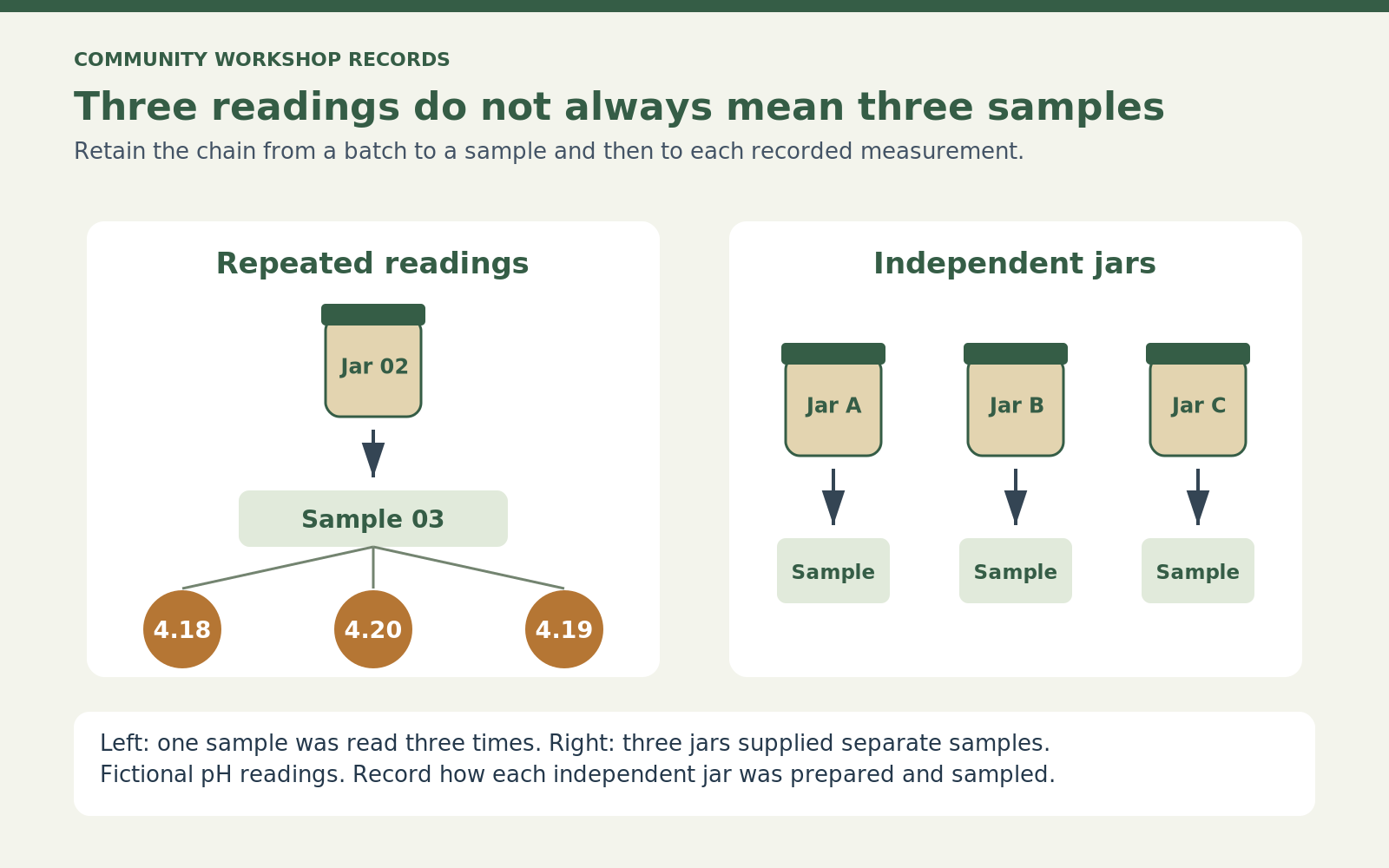
Reading the same prepared sample three times checks a different source of variation from preparing samples from three separate jars. Both can be useful, but they should not be counted as the same kind of replication.
Suppose one fictional jar produces three readings of 4.18, 4.20 and 4.19. Those observations describe repeatability for that sample under that procedure. They do not show that every jar in the batch has the same value.
A clear worksheet includes batch, jar, sample and repeat identifiers in separate columns. This structure makes it possible to summarize measurements later without accidentally treating every repeated display reading as an independent preparation.
Plot a trend without inventing missing observations
Use elapsed time on the horizontal axis and the measured quantity on the vertical axis. Show the actual observations as points. If a session was missed, leave the gap visible rather than inserting a plausible-looking number to make the line smooth.
In a constructed classroom example, measurements at zero, twenty-four and forty-eight hours might be shown as three points. A connecting line helps the eye follow their order, but it does not establish that the process changed linearly between those times.
Do not let a graph’s colour scheme turn a teaching record into an unverified food-safety clearance. Decisions about handling and consumption belong to the tested method and appropriate expertise, not merely to whether a point appears in a visually reassuring region.
Share the interpretation with its boundaries
At the end of the workshop, pair each chart with a short description of the recipe followed, sample identity, instrument and measurement procedure. Include unresolved entries instead of hiding them. A useful handover makes it possible for another person to understand what was observed and what remains unknown.
A pH trend describes acidity-related conditions; it is not a count of living microorganisms or an inventory of the molecules they produced. Those require different measurements. Recognising that boundary prepares a group to discuss fermentation biology without turning one accessible instrument into an answer to every question.
The notebook’s value lies in preserving relationships: which batch, which sample, which method and which time. That practical discipline creates a foundation for later discussions of organic acids, bacterial peptides and the experiments used to distinguish their roles.


